
murattunalı.
Reading

CASE 03 · Design + development

Karcem.

Multilingual B2B textile; sustainability certifications and a color-accuracy system.

LIVE → karcem.com.tr

PROBLEM

Karcem is a knit fabric manufacturer producing since 2015 — and its promise to buyers is numeric: color tolerance ΔE*ab ≤ 1, every incoming batch verified against that target with a spectrophotometer. The site has to carry that promise: telling a measurable quality claim, in seven languages, as a reference source rather than a supplier page.

APPROACH

Design and development put the color-accuracy system at the center of the narrative: process flow, laboratory verification and certifications on one line. With its Knowledge Center guides the site is a genuine content engine; the schema layer follows the type of each page (TechArticle in the guides, FAQPage on question pages, Service on service pages, VideoObject on the film page) and gives answer engines the same depth. Arabic is among the seven languages.

RESULT

  • 0.55 sload time on desktop
  • 0.58 sload time on a phone
  • 7languages
  • 621URLs

MEASURED: 2026-11-16

  1. LCP 552 ms · CLS 0.001 · TTFB 156 ms
  2. HTTP/3 · 7 languages · 621 URL sitemap
  3. llms.txt ✓ · AVIF + WebP · 37 req · 1,078 KB

IN SEVEN LANGUAGES

Buyers read in their own language.

  1. trTürkçe
  2. enEnglish
  3. deDeutsch
  4. nlNederlands
  5. ruРусский
  6. itItaliano
  7. arالعربية

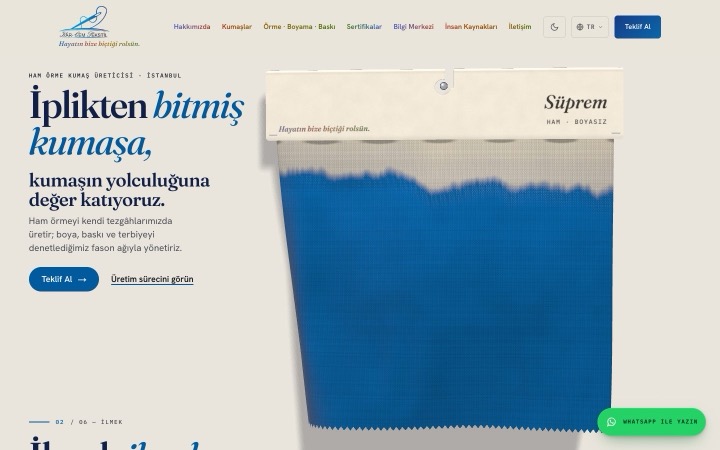
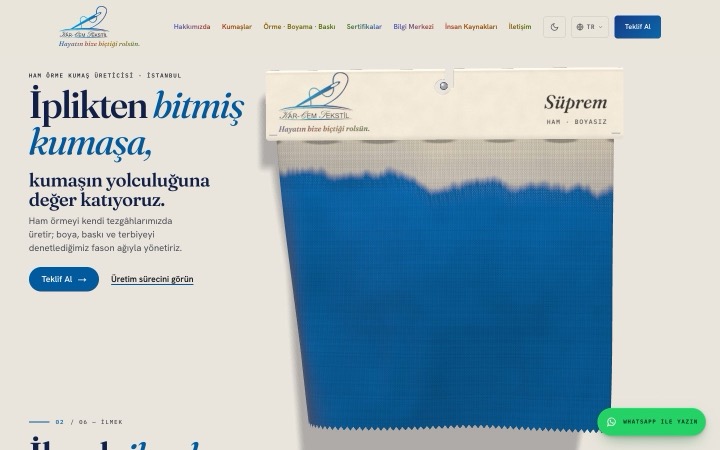
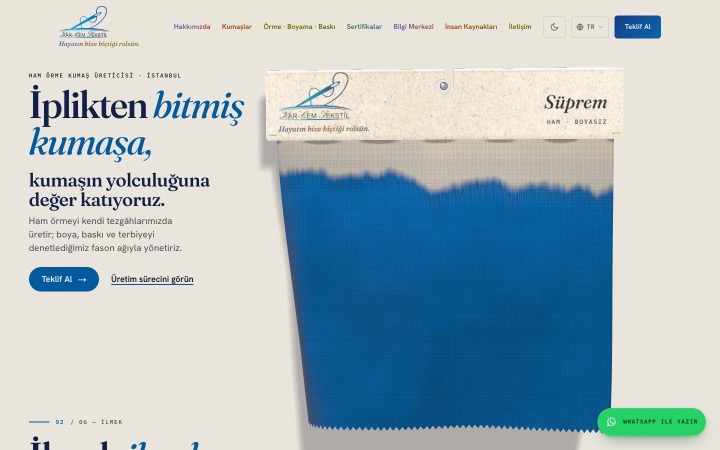
LOAD, FRAME BY FRAME

Opens in 0.55 seconds.

Frames from an animation-free recording; time from the case ledger (cold load, 1440×900, median of 5 runs).

Context

Karcem’s promise is numeric, and the site’s own heading states it as a number: a color tolerance of ΔE*ab ≤ 1. One of the 7 languages is Arabic, so the same numeric promise has to hold with the same precision in a different writing system.

  1. Color tolerance → ΔE*ab ≤ 1
  2. Every incoming batch → verified with a spectrophotometer
  3. # the site’s own claims, from the homepage

Strategy

The site presents quality as a system: the laboratory section sets the color criterion, the process flow shows where it is applied and the certifications state which standards production is certified against. The Knowledge Center guides deepen that chain with the questions buyers ask.

CLOSE-UP

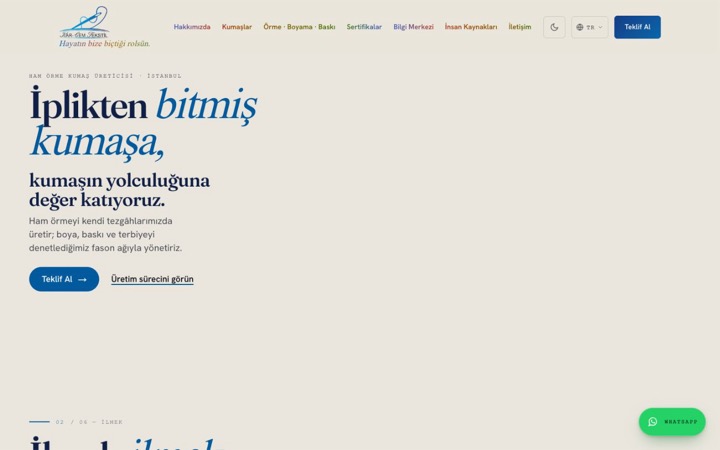
The crops are real regions of the live site; each caption is the section’s own heading.

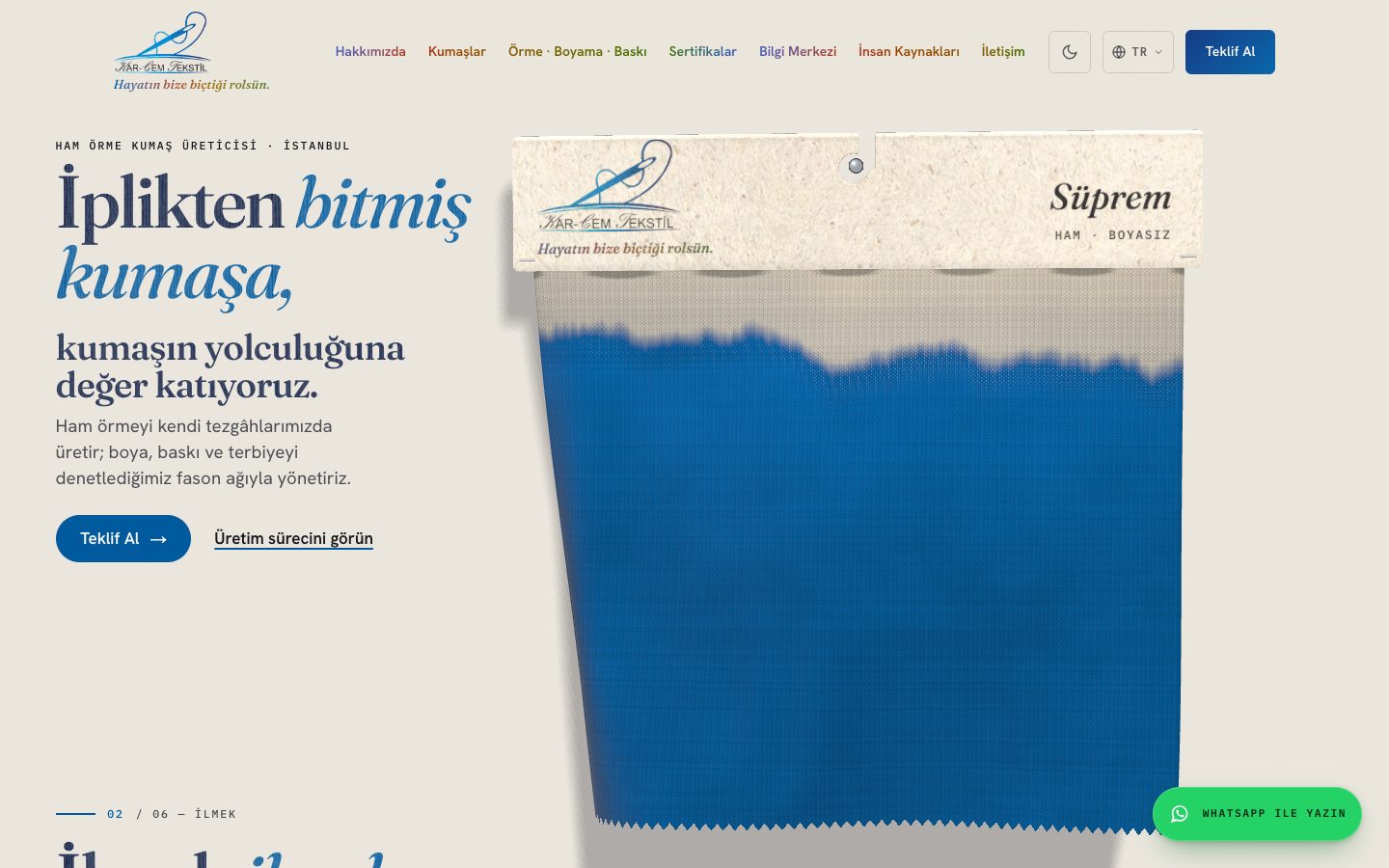
Renkte tolerans payımız ΔE*ab ≤ 1 — karcem.com.tr
Öne çıkan kumaşlar — karcem.com.tr
GOTS, OCS, GRS ve RCS Sertifikalı Örme Kumaş — karcem.com.tr
Örmede ustalık; kumaşın yolculuğunun her aşamasında değer. — karcem.com.tr
  1. 01Renkte tolerans payımız ΔE*ab ≤ 1 karcem.com.tr/
  2. 02Öne çıkan kumaşlar karcem.com.tr/
  3. 03GOTS, OCS, GRS ve RCS Sertifikalı Örme Kumaş karcem.com.tr/Sertifikalar.html
  4. 04Örmede ustalık; kumaşın yolculuğunun her aşamasında değer. karcem.com.tr/

Structure

The homepage carries the color laboratory, the featured fabrics and the process flow; the certifications and the fabric types have pages of their own, and the guides gather in the Knowledge Center. The sitemap holds 621 URLs.

ARCHITECTURE

The lines are measured layout: we read container width and section rhythm from the live page and draw nothing by hand.

karcem.com.tr
karcem.com.tr 1320px

Certification layer

On November 10, 2026, the site’s certificate page stated that for an order to count as certified, a transaction certificate issued for that lot is needed and that a scope certificate alone is not enough; in other words, it described the certificate at the level of the shipment, not the facility. The site has a separate page for verifying a transaction certificate, and the certificate page carries a hasCertification field in its structured data. Together with a numerical quality commitment such as the color tolerance, this builds a structure in which the claim and the certificate sit in separate layers on the same site. All the fields of the certificate record are in the certified manufacturer website guide.

Design

Headlines speak in a serif voice, Fraunces at weight 560. Beside black and white, the measured palette carries indigo, blue, brick, olive and ochre; on a site about color accuracy, the range itself is visible on the page.

MATERIAL

Fraunces — karcem.com.tr
Fraunces · 560 · 179px

Headline typography — we measure the specimen line from the live page’s computed style.

#000000 · #1b1a20 · #ffffff · #0867ac · #143d87 · #9c4a3c · #5f7a3a · #a67c2e

Measured palette: the page’s three most frequent neutrals plus its saturated accents.

Interaction

The interaction serves reading: video explainers sit beside the text, the questions buyers ask are answered in a section of their own, and the process flow makes the order of production traceable on the page.

MOBILE

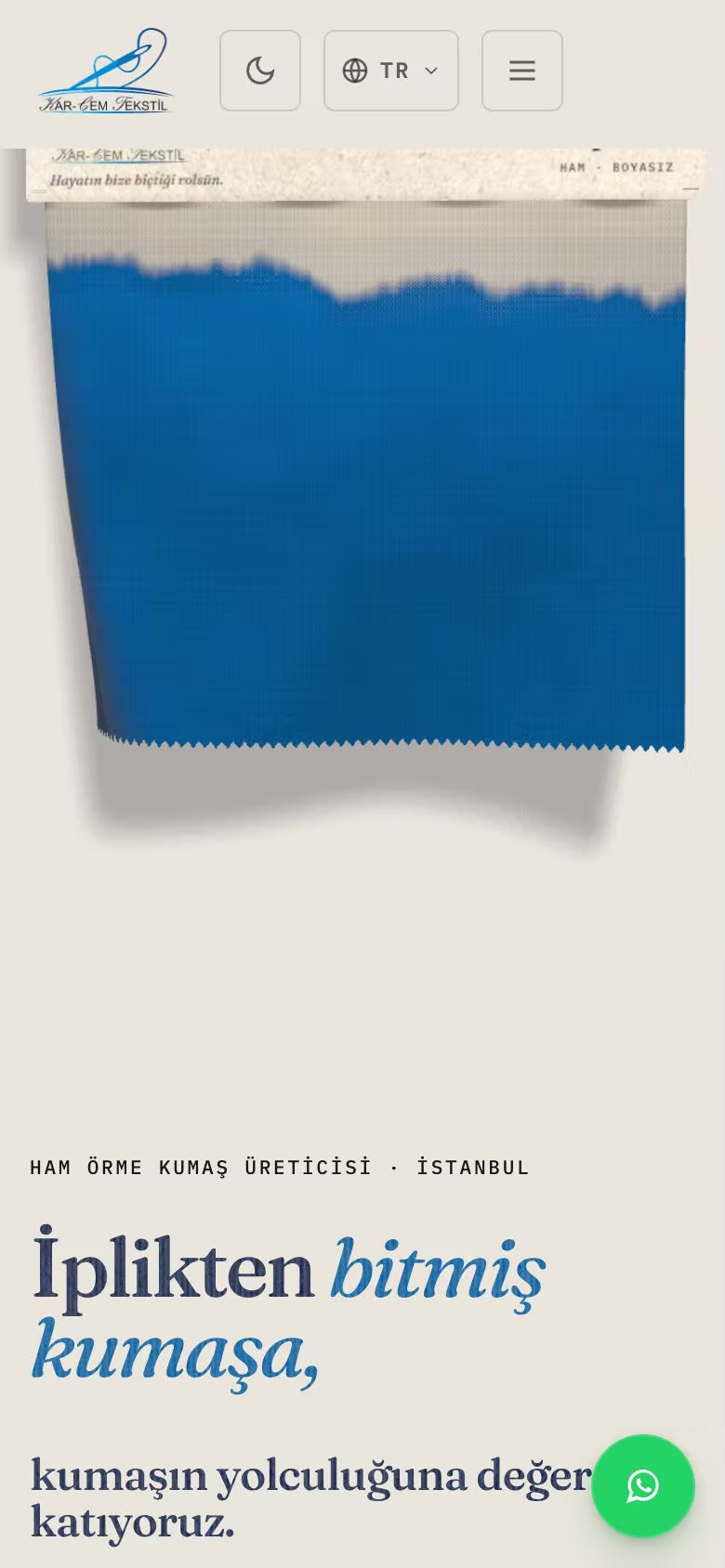
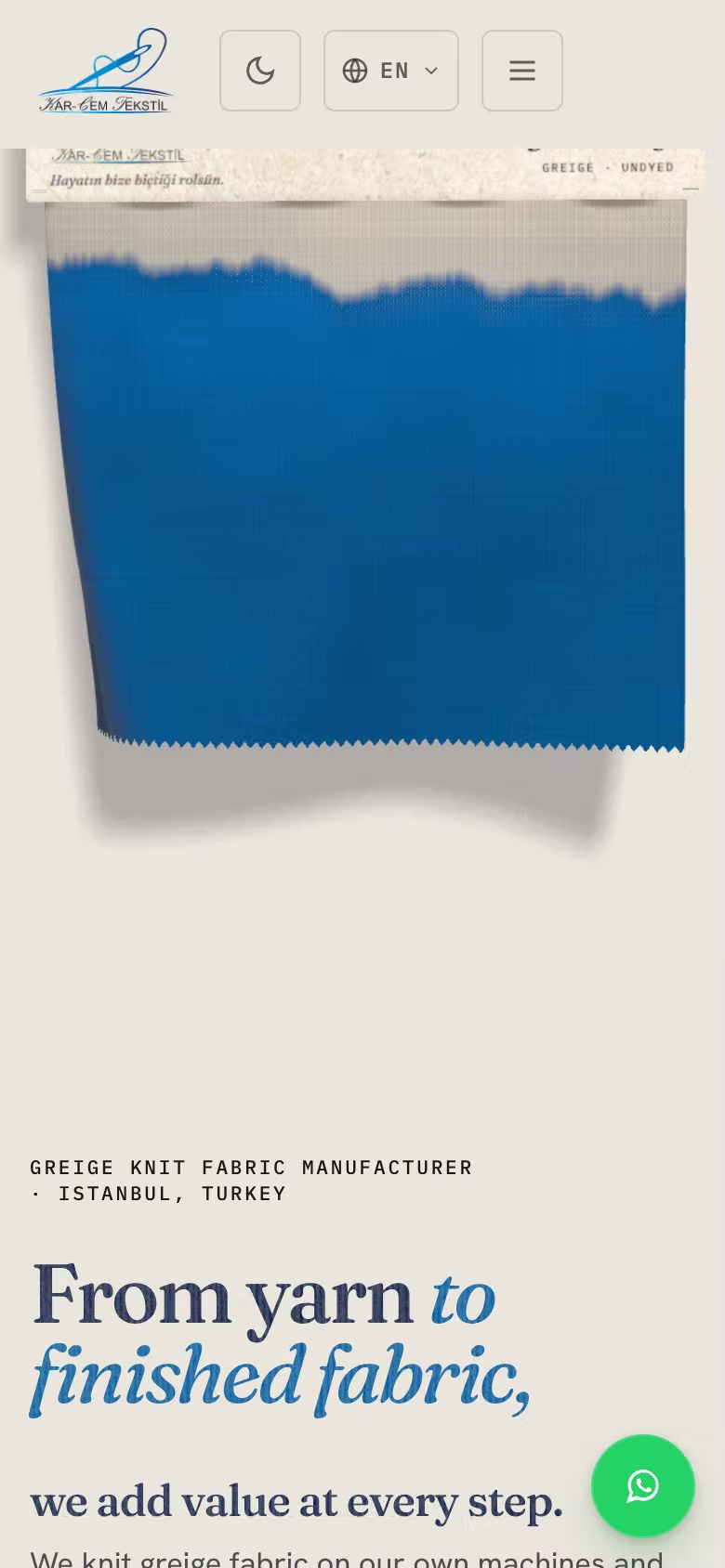
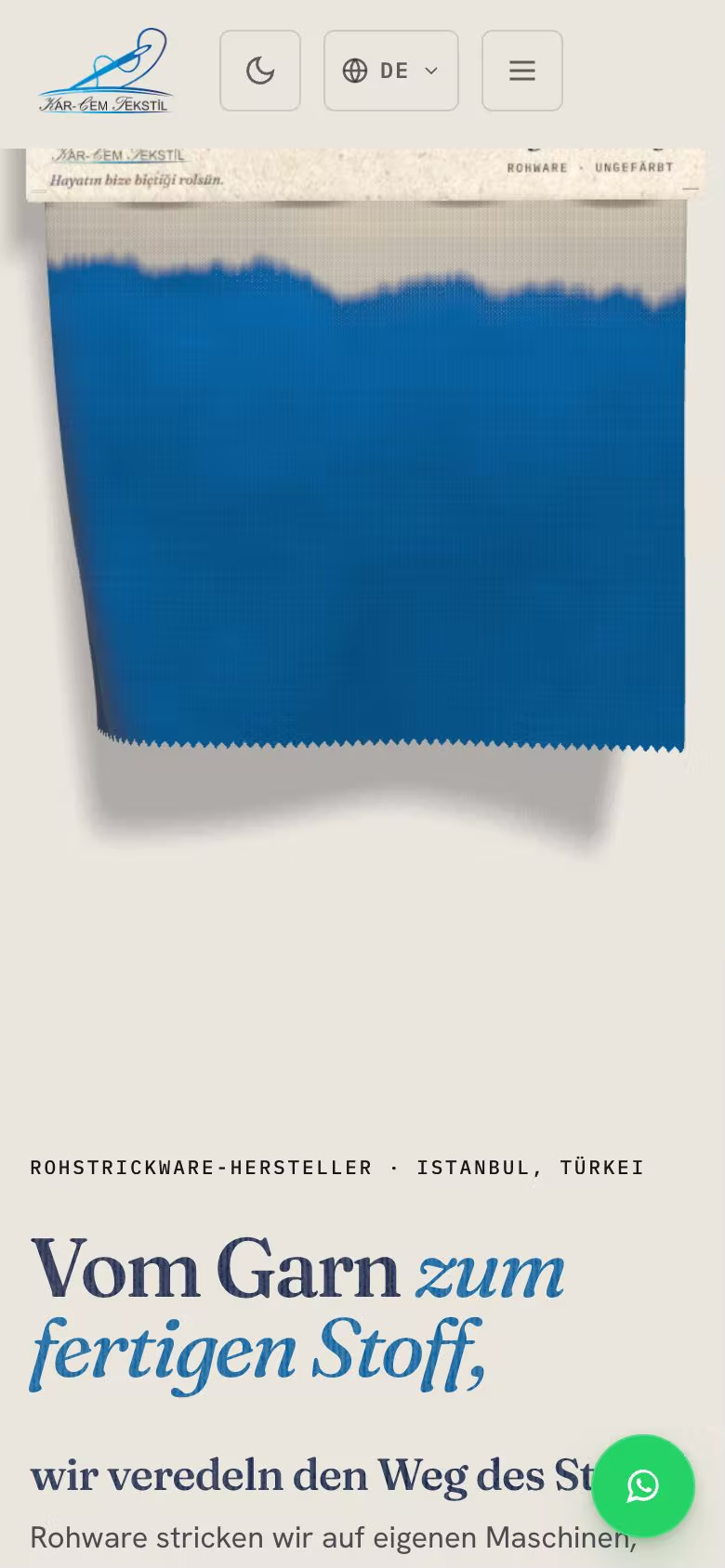
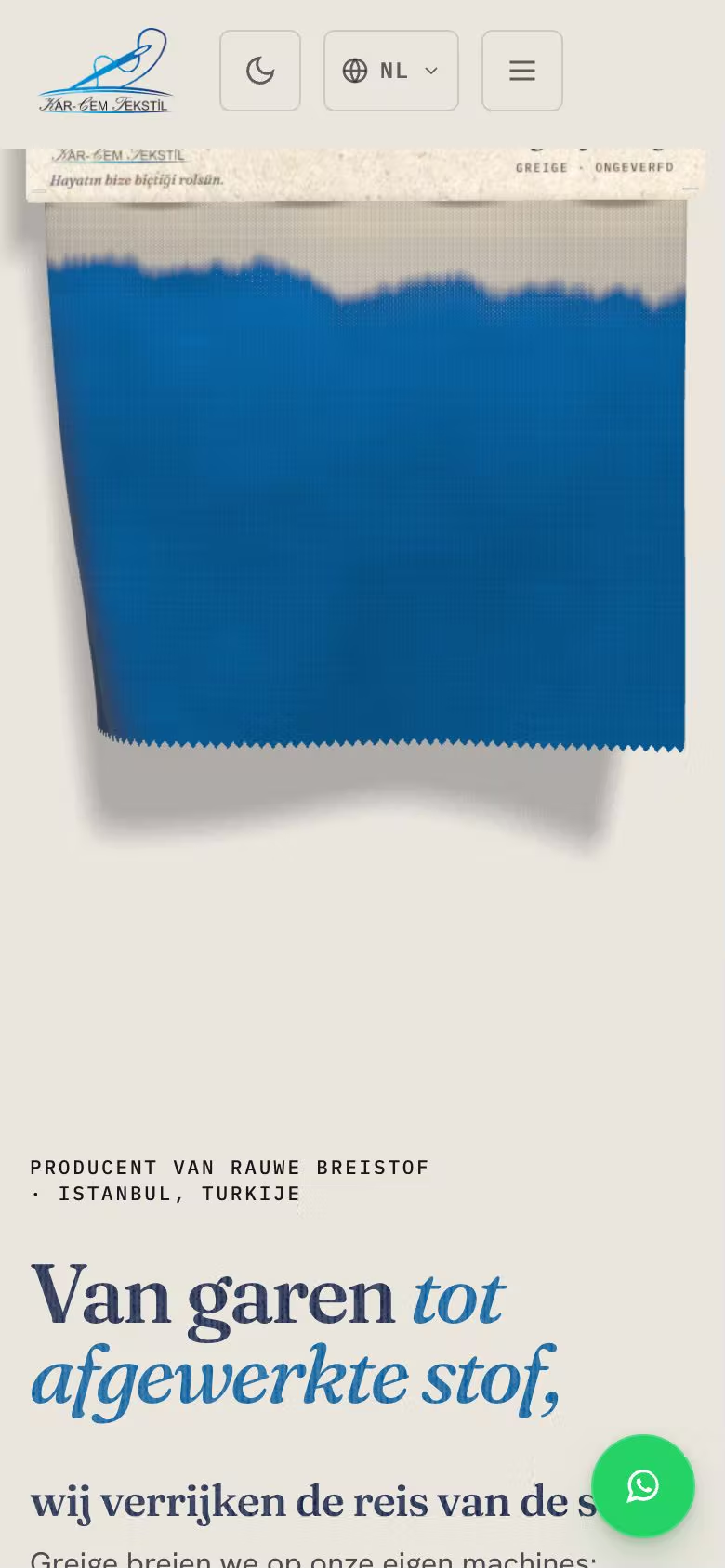
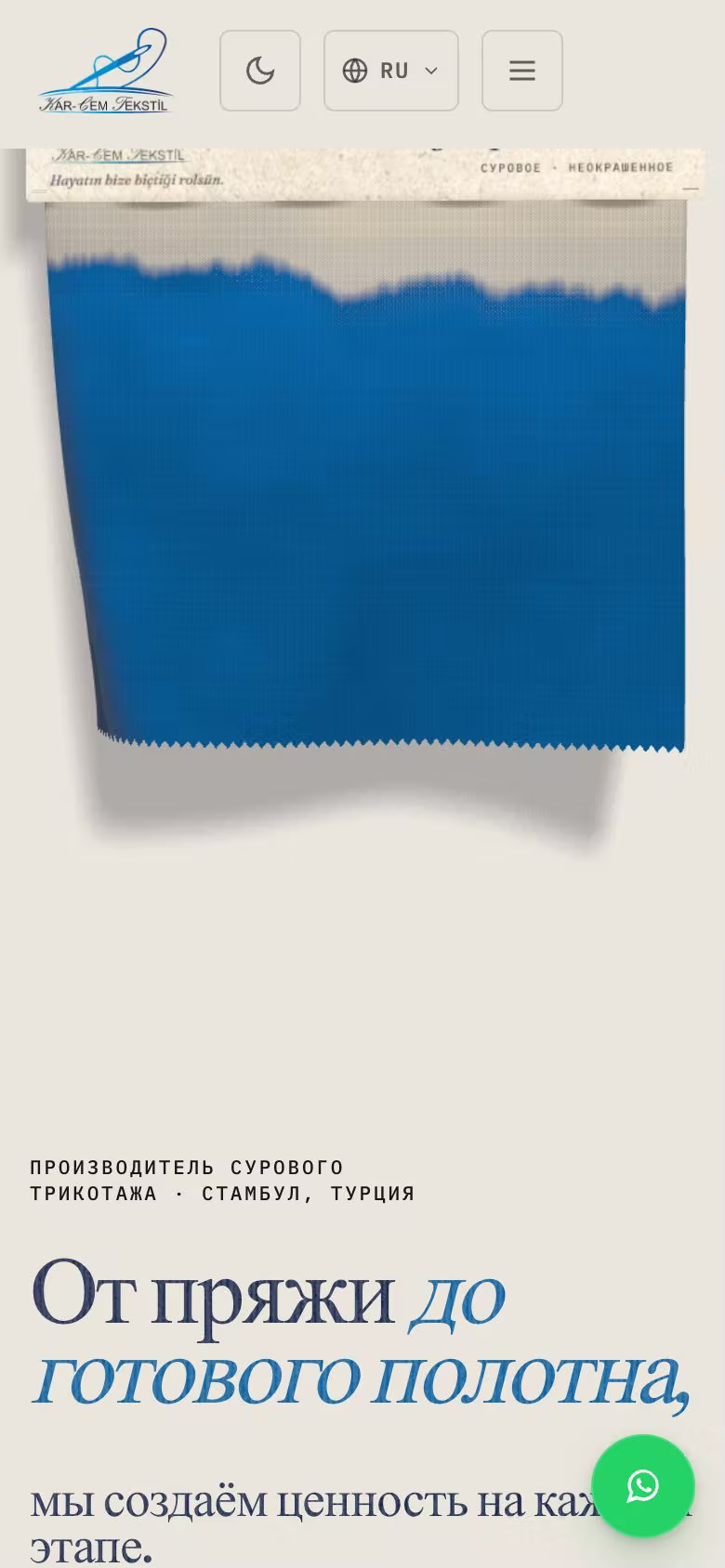
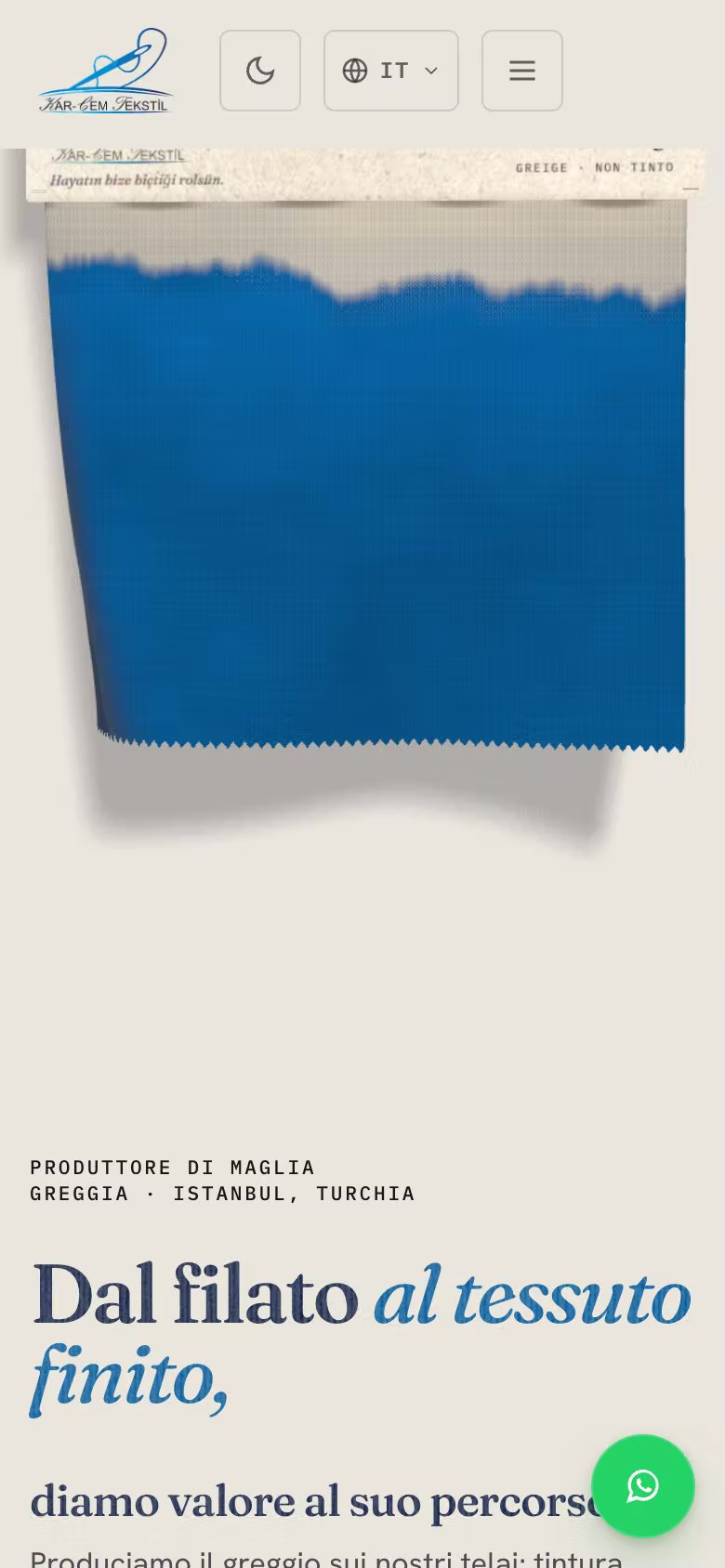
Three real 390 px frames; the alt text is the page’s own title.

Ham Örme Kumaş Üreticisi · Fason Boya & Baskı — KARCEM
Örme Kumaş: Çeşitleri, Gramaj Tablosu ve Üretimi — KARCEM
GOTS, OCS, GRS, RCS Sertifikalı Örme Kumaş — KARCEM
  1. 05Ham Örme Kumaş Üreticisi
  2. 06Örme Kumaş: Çeşitleri, Gramaj Tablosu ve Üretimi
  3. 07GOTS, OCS, GRS, RCS Sertifikalı Örme Kumaş

Lessons

A numeric promise turns into proof when it stands on the page as a number. At Karcem the color tolerance is written as a number in the laboratory section’s heading. For a machine reader the same rule applies to schema: a question and a video on the page stay a question and a video in the markup.

MEASUREMENT AND ARCHITECTURE

Measured values

Cold-load measurement dated November 16, 2026: Largest Contentful Paint 552 milliseconds, Time to First Byte 156 milliseconds, layout shift 0.001. Connection HTTP/3, images AVIF + WebP, 1,078 kilobytes transferred in total across 37 requests. Time to First Byte comes directly from the hosting and caching policy, without a separate optimization effort.

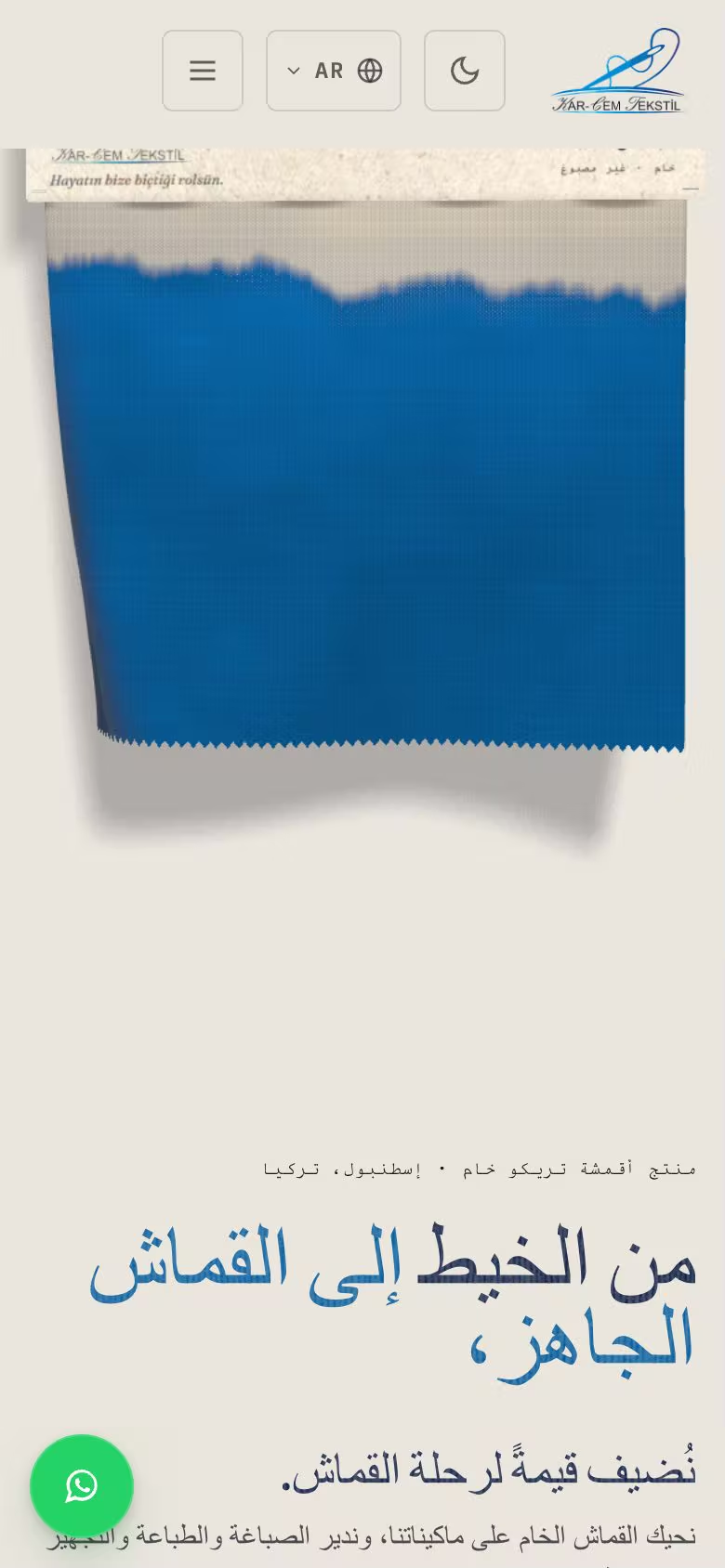
Seven languages and one right-to-left

The site runs in seven languages: Turkish, English, German, Dutch, Russian, Italian and Arabic. The last is a different job from the others: Arabic is written right to left, and that is not just a text-direction setting. The layout has to be mirrored, arrows have to turn around, and number and date formats need separate handling. The difference between adding a language to a list and delivering a page that genuinely works in that language shows up here.

The sitemap carries 621 URLs, and all seven languages are tied together by a reciprocal hreflang set. As the scale grows, managing this by hand becomes impossible; that is why the set has to be generated. We have written up what hreflang does and the difference between translation and localization separately.

The structure layer

The type of structured data follows the page itself: Organization and LocalBusiness on every page, a navigation trail (BreadcrumbList) on inner pages; TechArticle in the guides, FAQPage on pages with a question-and-answer section, Service on service pages, HowTo on process pages, VideoObject on the film page. LocalBusiness makes a physical business’s address, opening hours and contact details machine-readable.

The benefit of structured data is not ranking as such but clarity: the engine reads what the page is instead of guessing. Wrong or exaggerated markup backfires — declaring a feature that does not exist costs trust. We describe the basics and FAQ markup separately.

The cost of right-to-left

Supporting Arabic is more than adding a language, because the layout itself is mirrored. When the writing direction changes, the navigation order, margins, icon directions and list indents must change too. Adding this later means hunting down every layout rule written with a fixed direction in mind; building with logical properties from the start costs nothing extra.

Number and date formats are a separate item. The same date is ordered differently under different locales, and a hand-formatted date reads correctly in one language and wrongly in another. The right solution is to leave formatting to the browser’s locale layer. We explain what a locale is and how languages change text length separately.

The page decides the type

The number of structured data types is set by the page’s content: every entity that really exists on the page is marked up, and nothing that does not exist is. A guide is an article, a question page is questions and answers, a film page is a video: the type follows from what the page is. That is why the list of types grew as the site gained new kinds of pages.

Declaring what does not exist does direct harm. Marking up a frequently asked question that is not on the page, or putting product markup on every page, lowers the search engine’s trust and in some cases is grounds for a manual action. The rule is simple: markup describes only the page’s content. We have written up how errors are found separately.

621 URLs, one sitemap

The sitemap is kept in a single file. The protocol allows up to fifty thousand URLs per file, so there is no need to split at this scale. Splitting without need only makes maintenance harder. The file comes out of the generator; it is not edited by hand, and when a page is added its entry appears in all seven languages at once.

At scale, the real risk is the sitemap drifting from reality: a URL that is in the sitemap but not published promises the search engine a 404 and costs trust. The only reliable fix is to derive the sitemap from the GENERATED output, not from intent. We made the same mistake once in the repository behind this site; a measurement caught it, and we changed the sitemap’s source. We have written up the details separately.

The figures in this case are dated November 16, 2026 and change as the site changes; that is why the date always stands next to the number. Because the method is on record, we can run the same measurement again on request and show the difference. We do not count a claim of improvement that cannot be verified as an improvement.

Source

The site is live and its address is open on this page; the measurement can be repeated with the browser’s own developer tools. The structured data types declared on the page can also be verified by viewing the source — all of the markup sits in the page’s head as JSON-LD, and there is no hidden layer.