



murattunalı.
Reading

CASE 02 · Design + development

Fersan Tekstil.

Multilingual B2B textile site; motion-rich build with interactive calculators.

LIVE → fersantekstil.com

PROBLEM

Fersan is a fabric manufacturer producing since 1982, running the entire chain from yarn to dyeing in its own facility. The site carries exactly that load: telling a production story whose claims are audited by independent bodies — to buyers in seven languages, with proof.

APPROACH

Design and development were built as one: a motion-rich narrative layer, interactive calculators carrying the sample-to-shipment flow, and a complete hreflang set across all seven languages. The image layer is AVIF-first; a 1,488-URL sitemap comes out of a single generator.

RESULT

  • 0.76 sload time on desktop
  • 0.63 sload time on a phone
  • 7languages
  • 1,488URLs

MEASURED: 2026-11-16

  1. LCP 764 ms · CLS 0 · TTFB 251 ms
  2. HTTP/2 · 7 languages · 1,488 URL sitemap
  3. llms.txt ✓ · AVIF + WebP · 50 req · 1,970 KB

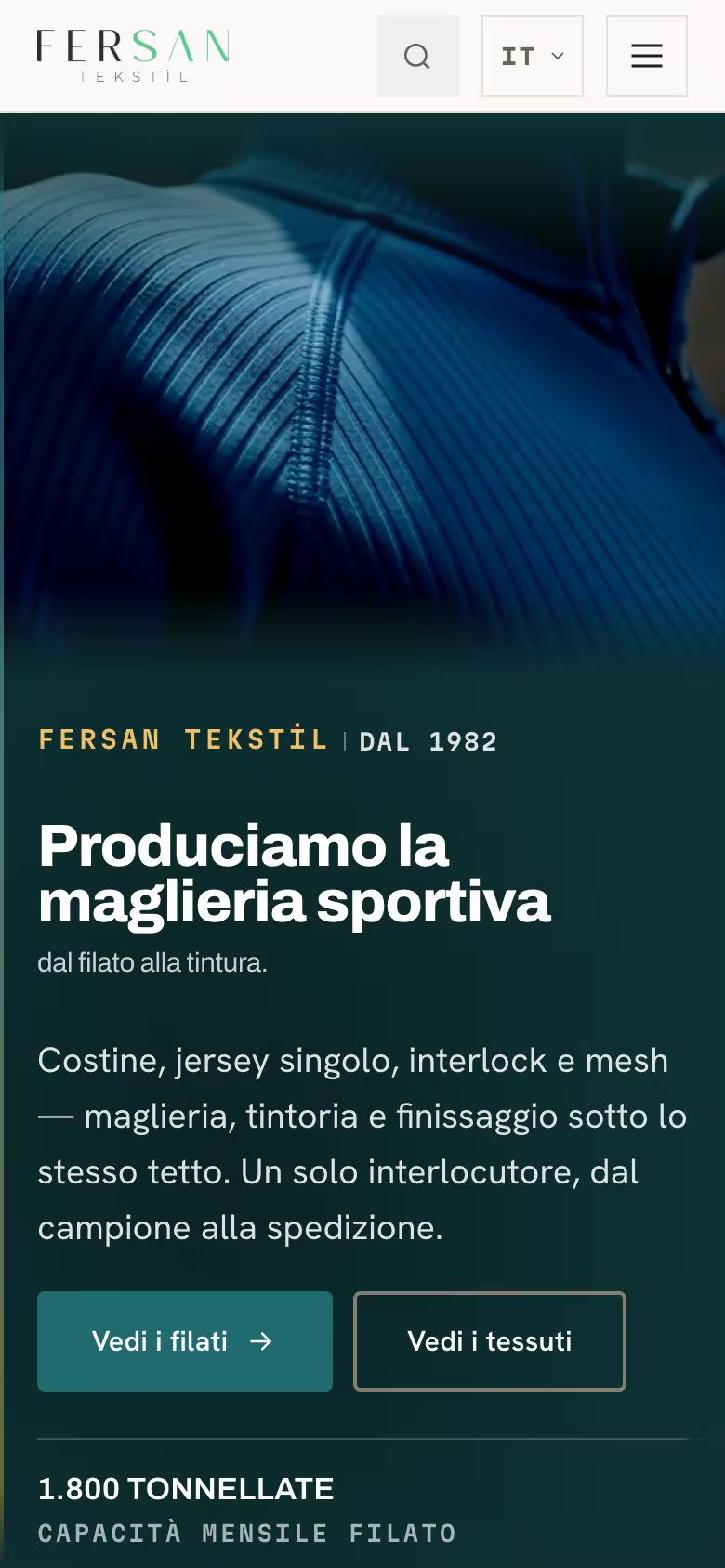
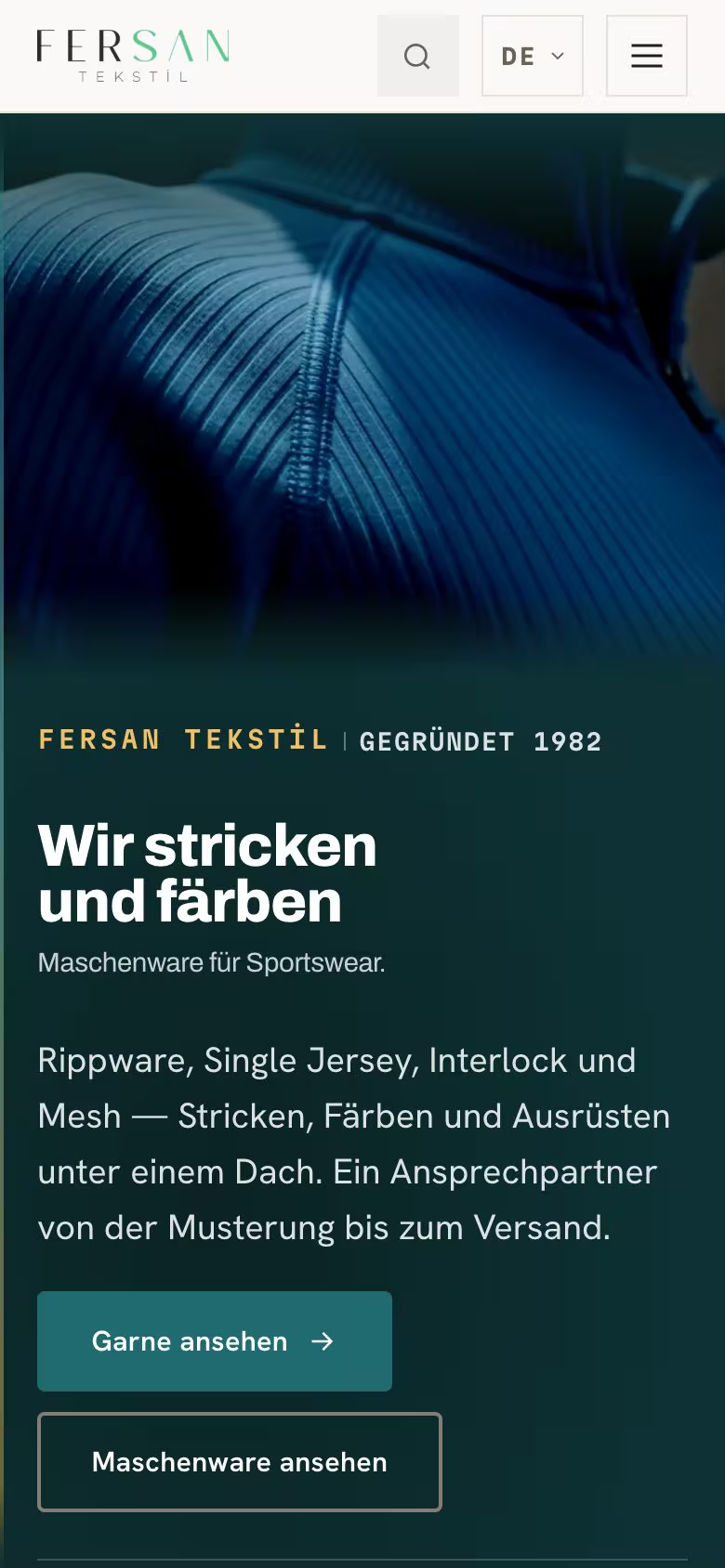
IN SEVEN LANGUAGES

Buyers read in their own language.

  1. trTürkçe
  2. enEnglish
  3. itItaliano
  4. ruРусский
  5. deDeutsch
  6. frFrançais
  7. esEspañol

LOAD, FRAME BY FRAME

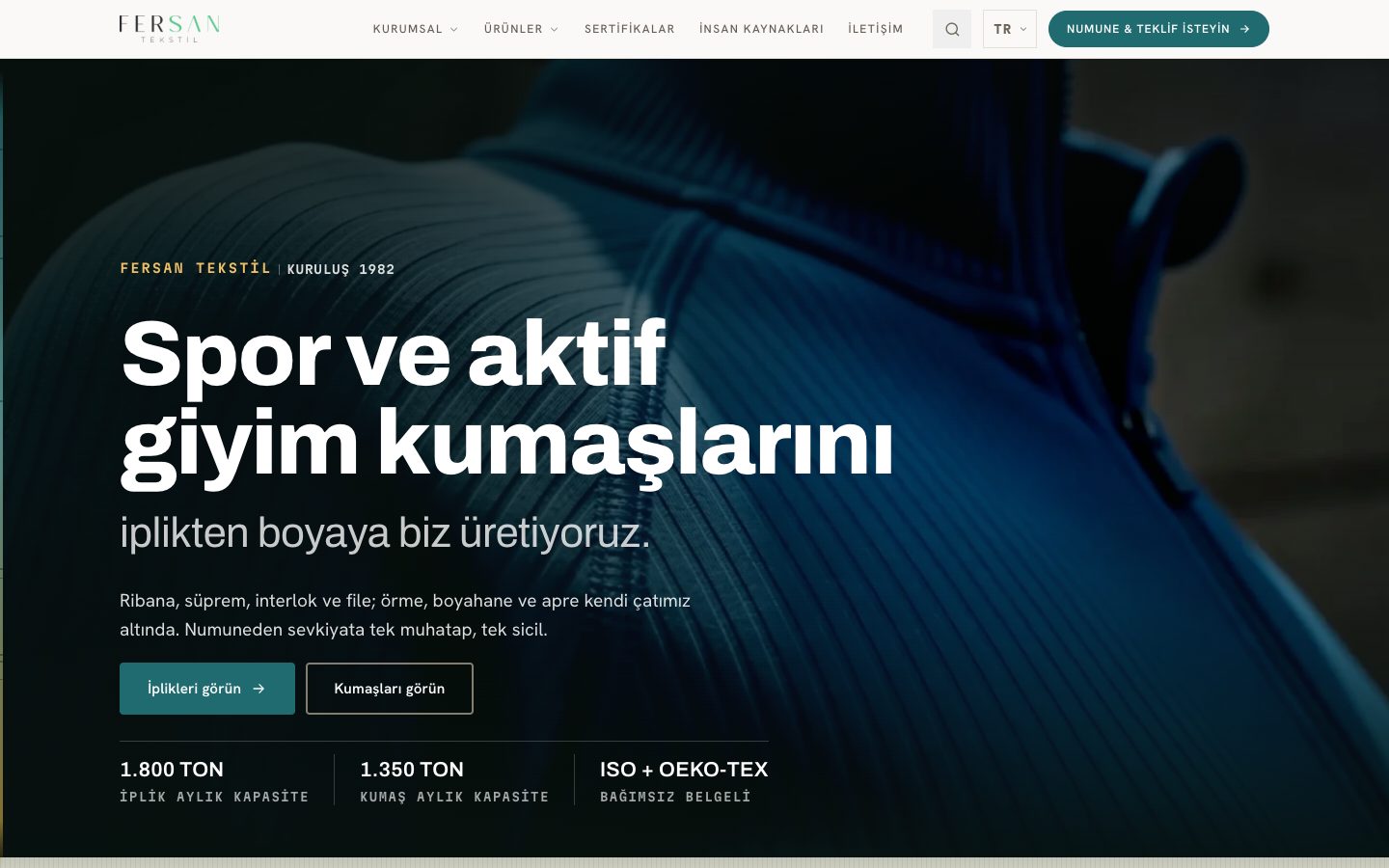
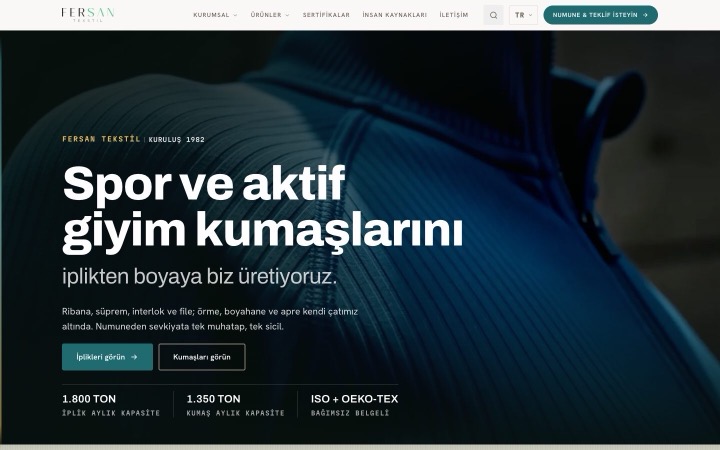
Opens in 0.76 seconds.

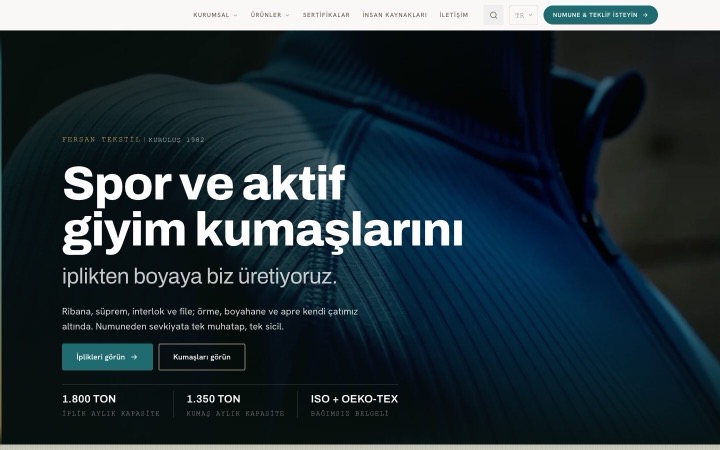
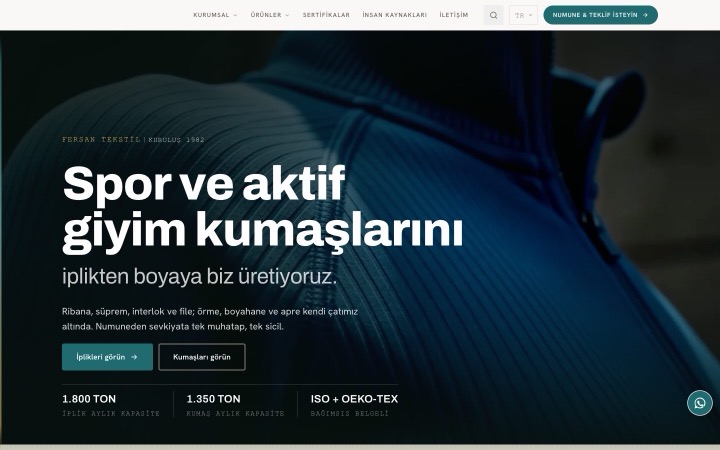
Frames from an animation-free recording; time from the case ledger (cold load, 1440×900, median of 5 runs).

Context

The site’s own section headings answer a buyer’s questions in order: where the collection comes from, where the yarn is spun and who certifies the quality. Answering those same questions with the same precision in 7 languages is the context of this work.

Strategy

Proof comes before claim. The production chain, the certifications and the sustainability data sit on separate surfaces, so every statement gets its own page and its own document. Motion carries the narrative from section to section but never stands in for the document.

CLOSE-UP

The crops are real regions of the live site; each caption is the section’s own heading.

Koleksiyonunuzun tüm kumaşları tek üreticiden. — fersantekstil.com
İpliğimizi kendi tesisimizde üretiyoruz. — fersantekstil.com
Bağımsız denetimle belgelenmiş kalite. — fersantekstil.com
Kumaşlarımızı tercih eden markalar — fersantekstil.com
  1. 01Koleksiyonunuzun tüm kumaşları tek üreticiden. fersantekstil.com/
  2. 02İpliğimizi kendi tesisimizde üretiyoruz. fersantekstil.com/
  3. 03Bağımsız denetimle belgelenmiş kalite. fersantekstil.com/sertifikalar.html
  4. 04Kumaşlarımızı tercih eden markalar fersantekstil.com/

Structure

The homepage carries the collection, the yarn and the brands that choose the fabrics; the certifications and the fabric catalog have pages of their own. The sitemap holds 1,488 URLs, all of them produced by a single generator.

ARCHITECTURE

The lines are measured layout: we read container width and section rhythm from the live page and draw nothing by hand.

fersantekstil.com
fersantekstil.com 1320px

Certification layer

On November 10, 2026, the site’s certificate page presented each certificate on a card with its scope, certificate number and issuing body; six of the ten cards also gave the expiry date, and the card of a certificate being renewed noted that renewal was in progress. For management system certificates, the accreditation body and accreditation number were also written next to the certification body. The page explained in a separate section which certificate proves what and what it does not, and stated plainly that there is no GOTS or organic cotton certificate. The FAQ stated, certificate by certificate, where and with which number a buyer can verify a certificate without asking the company, and also noted that the field is left empty for a certificate without a printed accreditation mark. The certificate page carries a hasCertification field in its structured data. All the fields of the certificate record are in the certified manufacturer website guide.

Design

Headlines are set in Archivo at weight 800, the loudest voice on the page. The measured palette lays petrol tones and ochre over dark warm neutrals; the image layer ships as AVIF + WebP, AVIF first.

MATERIAL

Archivo — fersantekstil.com
Archivo · 800 · 95px

Headline typography — we measure the specimen line from the live page’s computed style.

#1f1d1a · #645f54 · #686353 · #18565b · #1f6b70 · #0d3134 · #684a14 · #c2922f

Measured palette: the page’s three most frequent neutrals plus its saturated accents.

Interaction

Interactive calculators make the sample-to-shipment flow computable inside the page: the buyer does not just read the flow, they test it with their own input. Motion carries the transitions between sections.

MOBILE

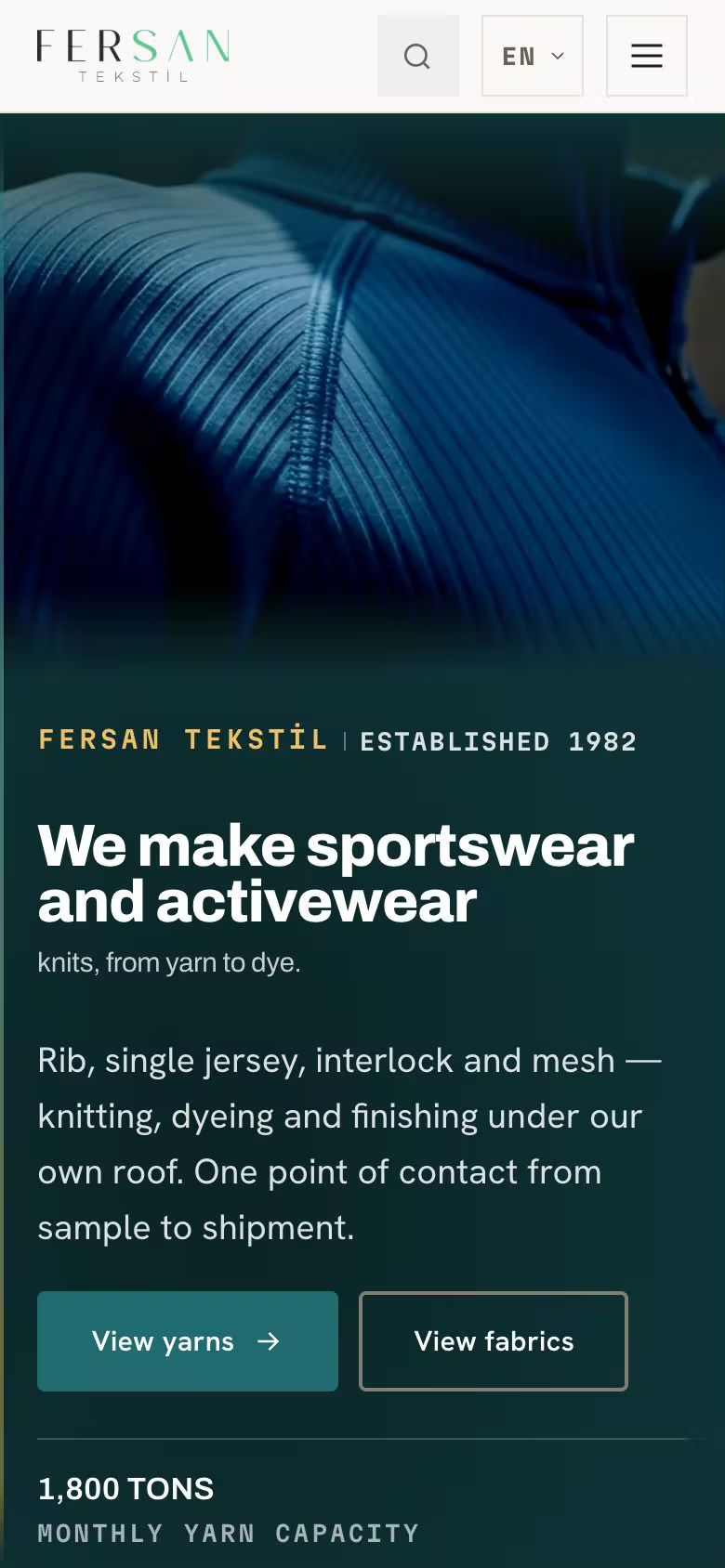
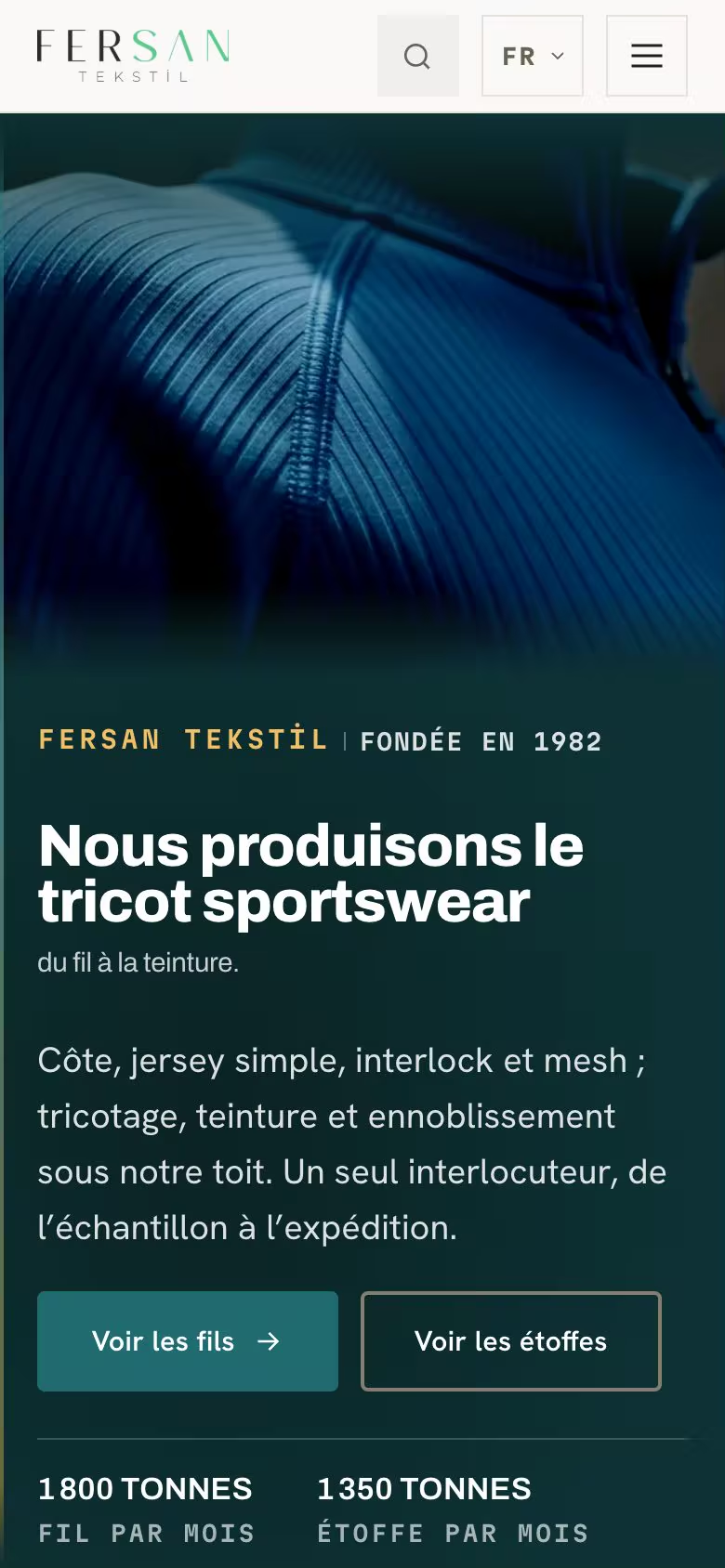
Three real 390 px frames; the alt text is the page’s own title.

Fersan Tekstil — Performans Örme Kumaş Üreticisi
Polyester Örme Kumaş Üreticisi — 42 Kumaş, 60–500 g/m²
Sertifikalar — ISO · OEKO-TEX · GRS — Fersan Tekstil
  1. 05Fersan Tekstil
  2. 06Polyester Örme Kumaş Üreticisi
  3. 07Sertifikalar

Lessons

One page holds two separate budgets: the total weight (1,970 KB · 50 requests) and the moment the main content appears (LCP 764 ms). In a motion-rich build, unless the two are measured apart, the weight gets blamed on the first screen.

MEASUREMENT AND ARCHITECTURE

Measured values

The measurement dated November 16, 2026 was taken on a cold load, on a 1440×900 desktop and with real Chrome; Largest Contentful Paint is the median of 5 runs. Largest Contentful Paint was 764 milliseconds, Time to First Byte 251 milliseconds and layout shift 0. All three sit well below Google’s "good" thresholds of 2.5 seconds, 800 milliseconds and 0.1 respectively. The connection runs over HTTP/2, images are served as AVIF + WebP, and the page completes in 50 requests with 1,970 kilobytes transferred in total.

Every figure comes from a single cold load, and that is said on purpose: a measurement on a warmed cache produces a nicer number but does not describe what the first visitor sees. The method is on record too — which browser, which resolution, which conditions. A number without its method cannot be verified.

Seven languages, one architecture

The site runs in seven languages: Turkish, English, Italian, Russian, German, French and Spanish. Including its sub-sitemaps, the sitemap carries 1,488 URLs. At this scale the real difficulty is not translation but consistency: every language version has to declare its own canonical, the reciprocal hreflang set must never break, and adding a page has to create all seven entries at once.

A multilingual setup run by hand breaks at this point — a language is forgotten, an hreflang stays one-way, a page never makes it into the sitemap. The solution is to generate the list from a single source: the URL tree, the hreflang set and the sitemap come out of the same data, so they cannot drift apart. We have written up the full architecture and the most common mistakes separately.

Why these numbers

An exporting manufacturer’s site also has to open quickly for buyers abroad and on mobile connections. Under those conditions Time to First Byte relates directly to how fast the page opens, and a difference of two hundred milliseconds is noticeable. In an image-heavy catalog, layout shift is the real risk: an image whose size was not reserved pushes the text down as it loads, and the reader loses the line they were on. The measured 0 shows that every image had its space set aside from the start. We describe how it was done separately.

What gets harder in seven languages

Difficulty does not grow linearly with the number of languages. Adding a page in two languages means two entries; in seven languages the same page means seven URLs, seven hreflang sets, seven sitemap entries and seven title tags. When one of these items is forgotten, the error is silent — the page opens, shows up and works; it just cannot be found in one language.

That is why the real decision in a multilingual architecture is made in the build flow, not in the file layout. When the URL tree, the hreflang set, the sitemap and the language switcher are generated from the same data, they cannot drift apart; when they are written separately, sooner or later they do. We follow the same principle in the repository behind this site, and the one time we broke it, a measurement caught it: when the language gate and the navigation read from different places, hundreds of links to four addresses broke.

What wasn’t changed

When a measurement comes out well, it has to be said what it is the result of; otherwise the number looks like magic. The values here come from three ordinary decisions: pages are served as static files, images are delivered in modern formats and at the right sizes, and no third-party scripts are loaded. There is no exotic technique. Finding them is easy; the real work is keeping them intact over the life of the project.

For the same reason we wrote the measurement up as a repeatable procedure. Because the method — browser, resolution, cold load — is on record, the same measurement can be run again six months later and the difference seen; if the number has not changed, that is information too. We have written up the trade-offs of a static setup separately.

1,488 URLs

The number of URLs in the sitemap comes from multiplying by seven languages, and at this scale crawl budget becomes a real constraint. A search engine does not give any site unlimited crawling; on a site with a thousand URLs, which pages are visited and how often is decided by looking at the change stamps in the sitemap and at the internal link structure.

That is why the last-modified stamp in the sitemap has to be true. Moving every URL’s stamp to today on each build is an easy shortcut, but it stops carrying information: if everything is new, nothing is new. The right thing is to advance the stamp only when the page’s content actually changes. We do the same in the repository behind this site; the stamp is tied to a content fingerprint. We have written up what crawl budget is and the multilingual sitemap separately.

No figure in this case was picked for marketing: whatever the measurement returned was written down, with its method next to it. Had a value not improved, it would stand in the same place.

Source

The site is live and its address is open on this page. Anyone who wants to repeat the measurement can disable the cache in the browser’s developer tools and reload to get the same values; for field data, the Chrome User Experience Report is a separate source.